
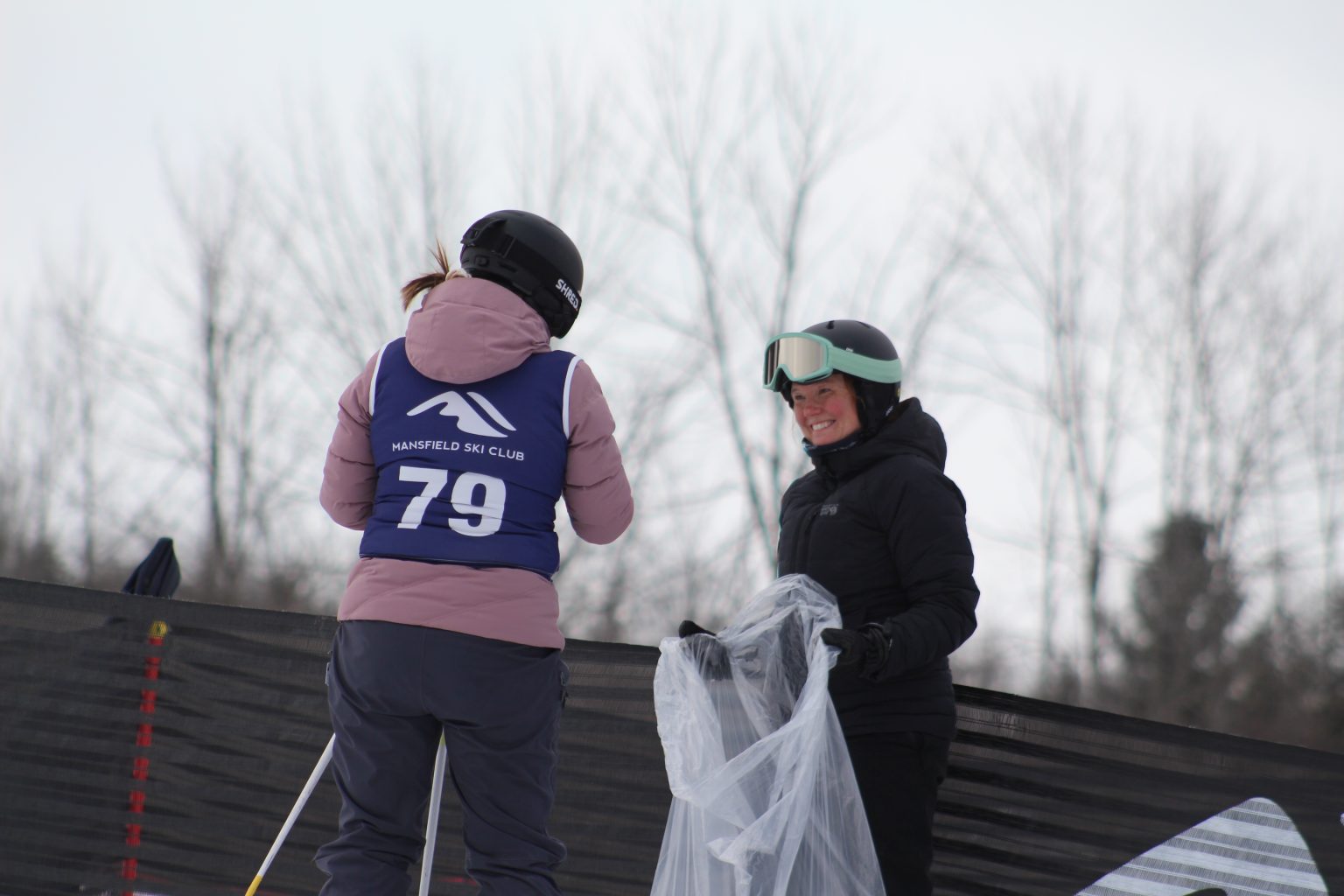
Mansfield Volunteer Race Crew

Mansfield will conduct ongoing training sessions to ensure our volunteers are comfortable and confident in ensuring our home races are executed flawlessly. We would like to develop a stable of volunteers that can be available to help with our home races.

Mansfield has a strong reputation for running the best ski races in Southern Ontario. A strong Race Crew ensures our races are well run. In order to continue to lead by example, the development of a qualified Race Crew is important to make sure we are supporting our athletes and enhancing our reputation in the ski community.

The Race Crew Consists of the Following Positions


Position
Description
Giant Slalom (GS)
Slalom (SL)

Chief of Gates

Organize the entire Race Crew and assign gates to the Gate Judges. After each run the Chief of Gates will deliver the score cards filled out by the gate judges and deliver them to the Jury.

1

1

Starting/ Coral Organizer

Organize athletes in sequential order at the start gate. Must have a Starting List from the Race Organizer.

1

1

Start Judge

Makes sure athletes have appropriate equipment and do not commit any infractions in the start gate. The Start Judge has a radio and will communicate with the Chief of Race, Announcer and the Starter. Can stop race and hold racer in starting gate when course needs to be slipped or there is an impediment on the course.

1

1

Gate Judge

The Gate Judges will be assigned a series of gates by the Chief of Gates to ensure that each athlete passes through the gates correctly (Ski tips and feet)

6

8

Finish Judge

Makes sure the athletes cross the finish line without any violations

1

1

Coat Runner

Will work with the Coral Organizer to take Mansfield Jackets etc. to the bottom of the hill for the athletes

1

1

Bib Collector

At the end of the 2nd run, the bib collector will collect the bibs from each athlete as the exit the finish coral

1

1

Slippers

Slippers will remove snow away from the turning poles on the racecourse and ensure there are no large mounds that could cause a racer to sustain an injury. Slippers must be aware that they are in a live racecourse and always aware when an athlete is approaching. Slippers must not be a visual distraction to any racer.

4-5

4-5

Gate Judge Cheat Sheet

  • All Race Crew members must wear a helmet when on the racecourse.
  • All Gate Judges must arrive at the top of the hill prior to the start of inspection. The Chief of Gates will meet you there and assign a series of gates for each gate Judge to monitor.
  • Skis and poles should be kept at the side of the course preferable on the other side of the netting. Bases to the snow with tips pointing down the hill and poles lying down.
  • The responsibilities of a gate judge are to observe the passage of athletes through the gates, record clear unbiased observations, and to know the rules. All race crew team members should adhere to the notions of Fairness and Safety.
  • Gate Keepers must fill in their cards correctly and add their cell number in case the Jury needs clarification at the end of the race.
  • If an athlete fails to pass through a gate correctly you must immediately record the competitor’s bib number and the gate number where the infraction occurred, accompanied by a drawing.
  • Do not watch the skier’s upper body as they pass through your section of gates, watch their feet. The Ski tips and the feet must pass on the correct side of the turning pole.
  • There are three types of infractions:
    1. Straddle (Str)
    2. Stop (Stop)
    3. Missed Gate (Miss)
  • Remember to constantly check the competitors’ bib number as they ski by – they are not always sequential, and they are easy to miss given the pace of the race. If there is an infraction and you miss the number:
    1. Make a note on the score card of the number of the racer that came afterwards.
    2. Ask the gate judge next to you if they caught the number
  • If a competitor loses a ski but passes through the gates correctly, they may continue.
  • The rule of three is a myth. (Skiers need to cross the finish line with three pieces of equipment is not valid)
  • When an athlete comes to a stop, they are not permitted to proceed and must ski out of the course. (This applies to all disciplines: DH, SG, GS, SL)
  • Always be aware of what’s happening on the racecourse above and below you. For Example, if there is a slipper on the course and a racer approaching, you should yell “Course” so the slipper knows to exit the course.
  • Make sure you can see your gates clearly – coaches, photographers and others should be asked to move if they are obstructing your view.
  • Gate judges can consult adjacent gate judges in order to confirm their opinion and can also walk to the gate, if safe, so that the tracks of the skier can be checked.
  • Competitors are permitted to ask the gate judge if a fault was committed. If asked, the Gate judge must inform the competitor if they have committed a fault that would lead to a DQ.
  • A competitor who is obstructed during their run and feels there has been interference must stop immediately and report it to the nearest Gate Judge. The competitor should not cross the finish line. The Gate Judge then records to details immediately on the score card and have it available to the Jury.
  • If a competitor falls and is hurt, signal for help. Do not touch the athlete.
  • At the end of each run, the Chief of Gates will collect your scorecard and submit them the Race Jury. Do not leave the hill until dismissed by the Chief of Gates.
  • Please ensure that Race crew badges and clipboards/pencils are returned to the Coaches Room in the Chili Shack.

The Score Card:

  • When you arrive at the pre-race meeting (usually 8:45 am at the Chili Shack) you will be given a clipboard with 2 or four Gate Judges Cards and pencils
  • The Chief of Gates will confirm the Name of the Race (e.g. U14 SOD) and if men and women will both be racing.
  • You will need at least two cards for men and an additional 2 cards for women. Typically, one card is used per run (a men and women’s race will therefore have 4 cards)
  • Fill out the front of the card with the relevant information. You won’t know your gate numbers until you’re on the racecourse with the Chief of Gates.
  • It is helpful if your cell number is included in case the Jury needs clarification at the end of the race.
  • When you have been assigned your gates, add them to the front of the score card in the space provided.
  • It is recommended that you then draw your gates in the space provided prior to the start of the race. Once the race starts the pace can be rapid and you may not have time to complete your drawing before the next racer comes.
  • It the race commits an infraction please write it as one of the following: STR for a straddle, STOP for a racer that comes to a stop, and MISS for a racer that misses a gate.
  • Add any notes you feel are relevant or add clarity
  • Be prepared to explain all faults to the Jury should they ask
  • The Jury consists of a Technical Delegate which represents FIS, a Referee which represents the athletes and coaches, and the Chief of Race.
  • When the run is over, please make sure to fill in the DSQ’s/Faults section on the card to make it easier for the jury to review


SEE BELOW FOR COMPLETED CARDS:

Start Referee and Finish Referee Responsibilities

The Start Referee (As per the International Ski and Snowboard Competition Rules – ICR) July 2025 edition

601.3.3 – The Start Referee

The Start Referee must remain at the start from the beginning of the official inspection time until the end of a training/event to:

  • Make sure that the regulations for the start and the start organization are properly observed.
  • Determine late and false starts.
  • Be a point of contact for the Jury at all times and immediately (see art. 705.5).
  • Report the names of the competitors who did not start to the Referee and informs the Jury of all infringements against the rules, such as false or delayed starts or violations against the rules for equipment.
  • Ensure that reserve bibs are available at the start.


601.3.4 – The Finish Referee

The Finish Referee must remain at the finish from the beginning of the official inspection time until the end of a training/event to:

  • Make sure that all the regulations for the organization of the finish and the finish in-run and out-run are properly observed.
  • Supervise the finish controller, the timing and the crowd control in the finish area.
  • Be a point of contact for the Jury at all times and immediately.
  • Report the names of the competitors who did not finish to the Referee and informs the Jury of all infringements against the rules.


Radio Protocol

This is the responsibility of the Chief of Race. A ski race has a lot of moving parts and a radio is the best way to keep things organized.

Golden Rule of Radio Communication: Do not speak unless spoken to!

Protocol:

  • All race communication must be on a single dedicated channel.
  • No other communication is to take place on that channel
  • Communication must be clear and concise
  • No Unnecessary talk

Who has a Radio on Race Day:


Position

Abbreviation

Chief of Race

COR

Technical Delegate

TD

Referee(s)

Ref

Timing

TM

Start Referee

SRef

Finish Referee

Fref

Chief of Gates

COG


Proper Radio Use:

Before speaking, position the radio microphone 5-10 centimeters from the mouth, shield from wind, key the radio microphone button, take a breath, then speak in a normal, modulated voice, pause, then release the microphone.

Race Morning:

  • Make sure all the race crew have a radio on the designated channel.
  • Review how to use the radio if needed.
  • Review race start and stop procedures:
    • Anyone may call a “Start-Stop”
    • Only COR may call a race start – “Start-start Send next racer”
  • Review Racer down protocol:
    • “Start-Stop” (anyone)
    • “Start-Stop confirmed. Holding bib #12 at the start, Racer 11 on course”
  • Review “Course Clear” (if needed)

Race Day Schedule:

  1. Jury Inspection
  2. Jury Inspection Complete:
    1. COR to TM: “Jury inspection complete, no concerns, gate count (# of turns and # of gates)”. “Course ready for athlete inspection as scheduled”
  3. Competitor Inspection:

COR:      Verify time is as scheduled

COR to TM:         “Course open for inspection” 15 minutes later

COR to TM          “Course is closed” 15 minutes later

COR to TM          “Course inspection is closed”

  1. Before Race Start:

COR to SRef: Verify Ski Patrol are at the top of the hill. SRef will verify after speaking with Ski Patrol

COR to TD: verify TD in place.

COR to Ref: verify Referee (s) in place.


  1. Race start or restart sequence:

“Course Clear” protocol must be CLEARLY communicated to the Jury before race is started

  1. If full view of hill COR can clear:

COR:             Verify start time as per program.

COR to TM   “Timing ready”                               

TM                 “Ready”

COR               “Course clear, start start, send first racer”


  1. If no full view of hill – full course clear “Bottom Up” required

COR :            Verify start time as per program.

COR to TM: “Timing ready”                               

TM:               “Ready”

COR:             “Course clear from bottom up please”

FRef:             “Finish clear”

TD:                “TD clear”

Ref:               “Ref clear”

SRef:             “Start clear”

COR:             “Course clear, start start, send first racer”

  1. COR: “Course clear, start start, send first forerunner.

When Forerunners complete runs:

COR to TD:  “Any concerns with course”         TD:         “Yes / No” Discuss if needed

COR to Ref: “Any concerns with course”         Ref:        “Yes / No” Discuss if needed

COR:             “Course clear, start start, send first racer”

  1. Race stop sequence:

This will be used if a racer is down, a flag is missing, a gate is damaged, or course repair is needed.

Any radio:           “Start stop”

Next SRef:           “Start stop confirmed, holding bib#123,(if racer has just left gate – bib#122 on course”)

When “Start stop” is confirmed, original radio should update and provide additional information if available.

When issue has been resolved,

Original radio to COR:  “area clear”

COR will now initiate a “Course Clear” if needed

  1. Restart race:

Only the COR can restart the race.

Reason for stop has been cleared.

If full view of hill:

COR:      “Course clear, start start, send next racer”

If no full view of hill:

COR:      “Course clear from bottom up please”

The people Clearing the course must be able to see the entire race run. The COR will make sure these people have proper visibility.

FRef:      “Finish clear”

TD:         “TD clear”

Ref:        “Ref clear”

SRef:      “Start clear”

COR:      “Course clear, start start, send next racer.”

  1. Race complete.

Timing will confirm that last racer has completed run and has a time.

COR:      “Race complete, course closed, jury to the timing hut”